















BREAKING: US and Iran Announce Peace Deal — 8 Things You Need to Know
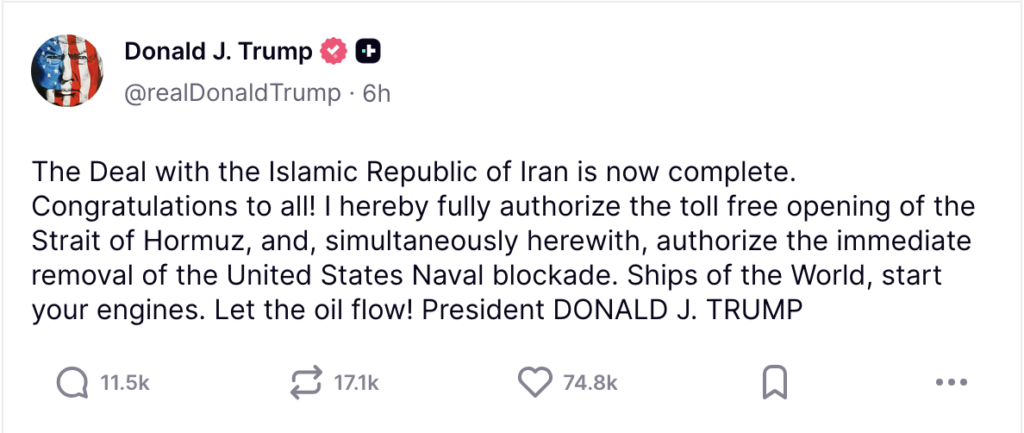
Today, the United States and Iran announced a preliminary peace deal aimed at ending nearly four months of conflict and reducing tensions across the Middle East. The official agreement is expected to be formally signed on Friday in Switzerland.
Here are the 8 key takeaways:
- Immediate ceasefire between the US and Iranian forces and an end to major military operations.
- Reopening of the Strait of Hormuz, a critical global shipping route through which roughly one-fifth of the world’s oil supply passes.
- Removal of the US naval blockade on Iranian ports.
- 60-day negotiations to address Iran’s nuclear program and broader long-term security arrangements.
- Iran’s commitment not to pursue nuclear weapons, according to Iranian officials involved in the talks.
- Potential sanctions relief, including a pause on new sanctions and discussions over lifting existing restrictions.
- Release of frozen Iranian assets, with reports indicating up to $25 billion could be unfrozen under future implementation stages.
- International support for implementation, with Pakistan playing a major mediation role and Western allies signaling support for diplomacy.
The agreement announced today is a preliminary memorandum of understanding. Several provisions remain subject to formal signing and follow-up negotiations over the next 60 days.
What remains to be determined:
- The future of Iran’s nuclear infrastructure and uranium stockpiles.
- The scope and timing of sanctions relief.
- Verification and enforcement mechanisms for both sides.
- Regional security issues involving Iran-backed groups and Israel.
The announcement triggered a sharp decline in oil prices and gains in global stock markets as investors reacted to the prospect of reduced geopolitical risk in the Middle East.
When will this lower gas prices?
The war sent US gas prices soaring more than 50%, with the national average climbing from roughly $3 per gallon before the conflict to a peak of $4.56. California drivers are hit the hardest, paying nearly $5.83 per gallon on average — the highest in the nation. Other states that followed suit include Washington ($5.61), Hawaii ($5.58), Oregon ($5.10), and Nevada ($5.01).
According to energy analysts, any meaningful relief at the pump will likely take weeks to months, even if the US-Iran peace deal holds. Experts say modest price declines could begin appearing within 1–3 weeks if the ceasefire holds and shipping through the Strait of Hormuz resumes, while more meaningful reductions may take 1–3 months as global oil and fuel supply chains normalize.
Economists say the peace deal is unlikely to have a major immediate impact on overall inflation, but it could help ease price pressures over time if it leads to lower oil and fuel costs. In the short term, consumers may see little change beyond energy markets, but over the coming months, lower transportation, shipping, and manufacturing costs could help slow inflation and reduce pressure on household budgets if the agreement holds and global energy supplies stabilize.
Is this a historic breakthrough or just a temporary pause in tensions? Join the discussion and share your opinion by signing up for a free account and posting directly to our LiveFEED!
If you value independent, public-focused journalism, subscribe to our YouTube channel and become a Member to help us continue covering the stories that matter.

About The Author